The Hidden Costs of “Doing Your Own Bids” vs. Using Pre-Negotiated Contracts from Native Purchasing Group
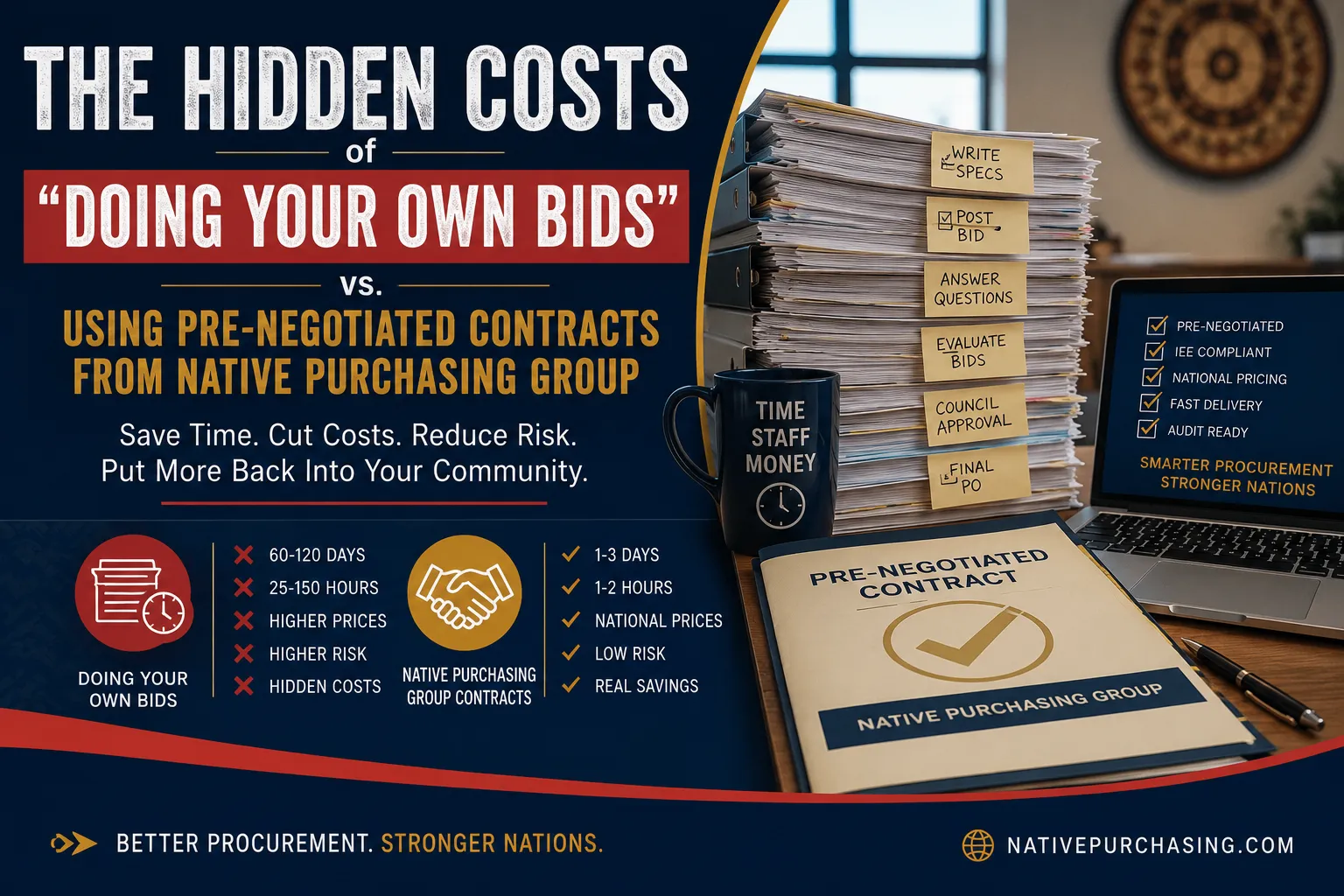
Every Tribal procurement team knows the drill. You need to buy 10 new work trucks, or restock your clinic, or order food for Head Start. Policy says you have to do a full bid. So you write specs, post it, answer questions, wait three weeks, review, score, get council approval, and finally issue a PO.
On paper, it looks like you are saving money because you got three quotes. In reality, doing your own bids is one of the most expensive things a Tribal organization can do.
At Native Purchasing Group, we work only with Tribal Nations and we see these hidden costs every week. That is why we built Native Purchasing Group as a 100 percent Native owned group purchasing organization that does the bidding for you, so you do not have to. Let us break down what doing your own bids are really costing your Tribe, and when using a pre negotiated contract from Native Purchasing Group is simply smarter.
What “Doing Your Own Bids” Actually Takes
When we say doing your own bid, we mean the traditional process. Your staff writes specifications, you publish a formal solicitation, you collect sealed bids or RFPs, you evaluate them, you document everything for compliance, and then you award.
It was designed to be fair and transparent, and it is. But it was designed at a time when there were no better options. Today, Native Purchasing Group has already done that exact same competitive process at a national level with hundreds of suppliers. The contracts from Native Purchasing Group are already bid, already evaluated, and ready to use.
So the real question is, are you paying twice to do the same work that Native Purchasing Group has already done for you?
The 7 Hidden Costs of Doing Your Own Bids vs Using Native Purchasing Group
1. Your Staff Time Is Your Biggest Cost
This is the one most Tribes never calculate.
A simple bid for office supplies or janitorial products takes 25 to 40 hours of staff time. A complex bid for construction, fleet, or medical equipment takes 80 to 150 hours. That is writing specs, posting, responding to vendor questions, opening bids, scoring, writing recommendation memos, and getting approvals.
If your buyer makes 35 dollars an hour with benefits, one simple bid costs you 875 to 1,400 dollars in time alone. A complex bid costs 2,800 to 5,250 dollars. And that is if everything goes smoothly.
Most Tribal Nations we work with at Native Purchasing Group run 20 to 50 bids a year. If you do the math, that’s a spend of 40,000 to 150,000 dollars a year just to run bids. That is one full time employee doing paperwork instead of serving your programs.
When you use a pre negotiated contract from Native Purchasing Group, that time drops to about 1 hour. You pick the contract from Native Purchasing Group, issue a PO, and you are done.
2. You Lose 60 to 120 Days Every Time You Bid
Time is money, especially for Tribal programs.
While you are waiting for bids to close, prices go up. Equipment you need sits in a dealer lot and gets sold to someone else. Your public safety team waits for radios. Your clinic waits for exam tables.
We saw this at Native Purchasing Group with a Tribe in the Southwest that needed to order kitchen equipment for their senior nutrition program. They started a bid in January. By the time it was awarded in April, the manufacturer had a 9 percent price increase and a 10 week backorder. If they had used our tribal food service procurement contract from Native Purchasing Group, they could have ordered in January at the locked contract price and had delivery in two weeks.
Delays also push projects into the next fiscal year, which creates grant spend down issues that Native Purchasing Group helps you avoid.
3. You Almost Never Get the Best Price on Your Own
This is hard to hear, but it is true. One Tribe buying 15 laptops will never get the same price as 300 Tribes buying 15,000 laptops together through Native Purchasing Group.
Suppliers give better pricing based on volume. When you bid on your own, you get a local or regional price. When you buy through a national pre negotiated contract from Native Purchasing Group, you get national account pricing because Native Purchasing Group represents the collective buying power of Tribal Nations.
In our last analysis at Native Purchasing Group which we shared in our blog on how much Tribes really save with a group purchasing organization, Tribes were paying 20 to 40 percent more on office supplies, 18 to 28 percent more on fleet, and 15 to 30 percent more on medical supplies when buying on their own versus our contracts from Native Purchasing Group. The product was identical. Only the contract was different.
So you may think you saved money by getting three quotes, but all three quotes were higher than the Native Purchasing Group price to begin with.
4. Compliance and Legal Risk Is Higher Than You Think
Every bid has to be perfect. If you miss a posting requirement, if your specs favor one vendor, if your evaluation is not well documented, you open your Tribe up to a bid protest.
A bid protest can freeze your purchase for months. It can force you to re bid everything. It creates friction with council and vendors.
Worse, for Tribes using federal funds from IHS, BIA, or USDA, you also have to meet Indian Economic Enterprise or Buy Indian Act requirements. If you do your own bid and you do not document IEE correctly, you can have audit findings.
Our pre negotiated contracts at Native Purchasing Group are already competitively solicited and documented. Native Purchasing Group is 100 percent Native owned and IEE certified, so when you use our contracts from Native Purchasing Group, you are using an IEE compliant path. Your file is audit ready with the solicitation, evaluation, and award documentation from Native Purchasing Group already attached.
5. Your Program Staff Gets Frustrated and Starts Workarounds
This is the cost no one puts on a spreadsheet, but we see it at Native Purchasing Group all the time.
When procurement takes too long, program directors get frustrated. They start splitting purchases to stay under the bid threshold, they use personal cards and ask for reimbursement, or they just stop ordering what they need.
We have heard from Tribal education directors who delayed ordering classroom furniture for months because they did not want to go through another bid. We have seen public works teams rent equipment at three times the purchase price because buying it would require a bid they did not have time for.
That hurts your programs and your people. Native Purchasing Group was created to stop that exact problem.
6. You Miss Volume Discounts and Rebates Across Departments
When each department does its own bid, your Tribe buys like five small organizations instead of one large one.
Example: Your clinic buys gloves from Vendor A. Your schools buy gloves from Vendor B. Your casino buys gloves from Vendor C. All three pay retail.
With a centralized pre negotiated contract from Native Purchasing Group, all gloves go to one contract, one supplier, one price, and you get volume rebates at the end of the year. One Tribe in the Northern Plains consolidated just janitorial and office supplies to one contract from Native Purchasing Group and saved an extra 8 percent from rebate alone.
7. Construction and Infrastructure Costs Blow Up
This is critical for anyone handling tribal construction purchasing. When you bid a construction project, you are bidding labor and materials together. If your bid takes 90 days, lumber and steel prices can jump 10 percent in that time and the contractor passes it to you through change orders.
By using pre negotiated contracts for materials, heavy equipment, and building supplies from Native Purchasing Group, you can lock material costs early and even direct purchase materials to avoid contractor markup. We have seen Tribes at Native Purchasing Group save 12 to 22 percent on construction projects just by separating materials onto our contracts.
Doing Your Own Bids vs. Pre-Negotiated Contracts from Native Purchasing Group
| Factor | Doing Your Own Bid | Using Native Purchasing Group Contracts |
| Time to Purchase | 60 to 120 days | 1 to 3 days with Native Purchasing Group |
| Staff Time Per Buy | 25 to 150 hours | 1 to 2 hours with Native Purchasing Group |
| Price You Get | Local small volume price | National high volume price from Native Purchasing Group |
| IEE Compliance | You must document and defend | Already IEE certified by Native Purchasing Group |
| Audit Risk | High if any step is missed | Low, full bid file provided by Native Purchasing Group |
| Cost to Run the Process | 1,400 to 5,000 dollars per bid in staff time | Zero with Native Purchasing Group |
When Should You Still Do Your Own Bid?
Pre negotiated contracts from Native Purchasing Group are not for everything. You should still do your own bid when you have a very unique service, like a cultural center design, or a highly specialized construction project where local knowledge matters more than materials.
But for 80 percent of what Tribes buy every year, fleet, office supplies, technology, food, medical supplies, public safety equipment, furniture, MRO, and building materials, a pre negotiated contract from Native Purchasing Group will be faster, cheaper, and safer.
The best procurement teams we work with at Native Purchasing Group have a simple rule. If we can get it on a compliant pre negotiated contract from Native Purchasing Group that is IEE certified and saves us time, we use it. If not, we bid it. That rule alone has cut their bid workload in half.
What This Means in Real Dollars with Native Purchasing Group
Let us do quick math for a Tribe running 30 bids a year.
30 bids x 40 hours average x 35 dollars per hour = 42,000 dollars in staff time
30 bids x 75 days average delay x program impact = hard to quantify but huge
Price difference of 15 percent on 3 million dollars of biddable spend through Native Purchasing Group = 450,000 dollars overpaid
Total hidden cost: Over 490,000 dollars a year that Native Purchasing Group can help you recover.
You could hire two more people for your programs, replace your aging patrol vehicles, or renovate classrooms with that money.
How to Switch to Native Purchasing Group Without Changing Your Policy
You do not need to rewrite your procurement policy to start saving with Native Purchasing Group.
Our contracts at Native Purchasing Group are competitively bid in a way that satisfies most Tribal procurement codes and federal Uniform Guidance. You can use Native Purchasing Group as an exception to bidding for pre-competed contracts. Many Tribes are already doing this with cooperative purchasing organizations, however we include an added benefit of IEE compliance that only Native Purchaing Group provides.
Here is the simple process with Native Purchasing Group.
- Register your Tribe for free membership with Native Purchasing Group. It takes five minutes on Native Purchasing Group.
- Native Purchasing Group gives you access to our contract portfolio and all the backup bid documentation for your files.
- When you need something, you check if Native Purchasing Group has a contract for it. If yes, you issue a PO to the supplier at our price. You track your savings with Native Purchasing Group.
- If you want, Native Purchasing Group can look at your current spend and show you exactly which bids you can stop doing immediately and how much you will save. Just reach out through our contact us page and the team at Native Purchasing Group will prepare a free analysis.
Doing your own bids made sense ten years ago. Today, with staff shortages, rising prices, and increasing compliance requirements, it is one of the most expensive habits a Tribal organization can keep. Pre negotiated contracts from Native Purchasing Group give you back time, reduce risk, and put money back into the community where it belongs.