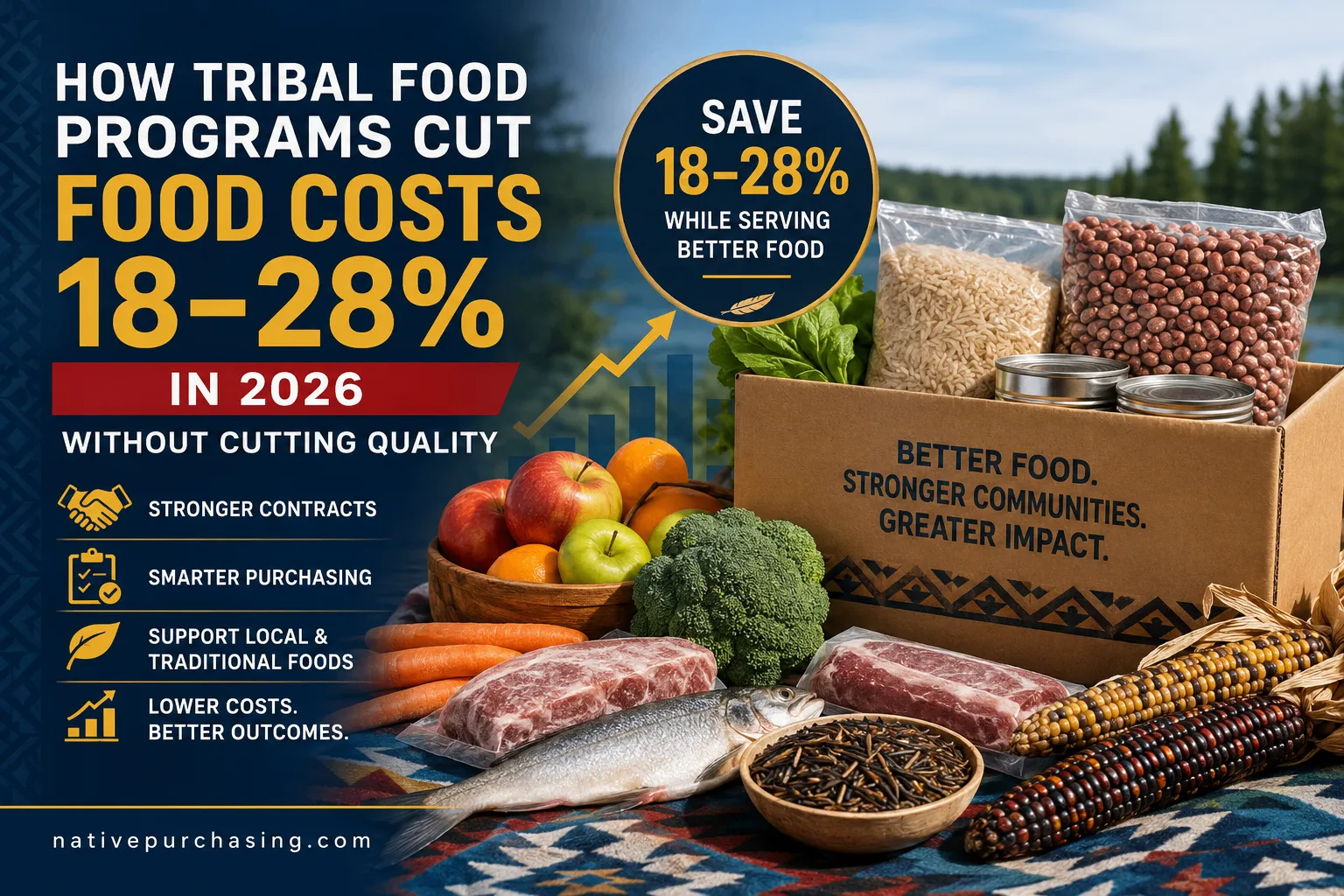
How Tribal Food Programs Cut Food Costs 18 to 28% in 2026 Without Cutting Quality
If you run a tribal food program in 2026, you feel it every invoice. Chicken that was 45 dollars a case two years ago is now 62 dollars. Produce shows up short. Bread goes stale faster because deliveries are stretched. Your budget has not kept up.
At Native Purchasing Group, we spend every day with FDPIR managers, elder nutrition coordinators, Head Start cooks and tribal procurement officers. What we see is consistent. Tribes are not overspending because they are careless. They are overspending because they are buying the way the old system taught them to buy. Spot orders, too many vendors, vague specifications, and emergency runs to the store.
Tribes who fixed five to seven basics with help from Native Purchasing Group are seeing 18 to 28 percent savings this year, and their food quality is better. Here is how they do it.
Why Costs Are Still High in 2026
Three things are hitting at once.
First, supply chain fragility.
After USDA moved FDPIR distribution to a single contractor operating from a single warehouse, many programs saw delayed, incomplete and missing deliveries skyrocket. When the truck does not arrive, you buy at retail to fill the gap.
Second, the cost to move food is higher.
Fuel, cold storage and driver wages are up. Rural delivery adds a surcharge that never shows on the price list.
Third, programs are shifting.
USDA is now putting power back in the hands of tribal nations to select and purchase foods for their FDPIR packages directly rather than going through USDA. It has added eight additional tribes to the Self Determination Demonstration Project. USDA is also leveraging the Local Food Purchase Assistance Program, or LFPA, to allow tribal governments to buy regional foods. That is a huge opportunity, but only if your process is ready.
You cannot control the market. You can control how you buy.
What Cutting Quality Really Means
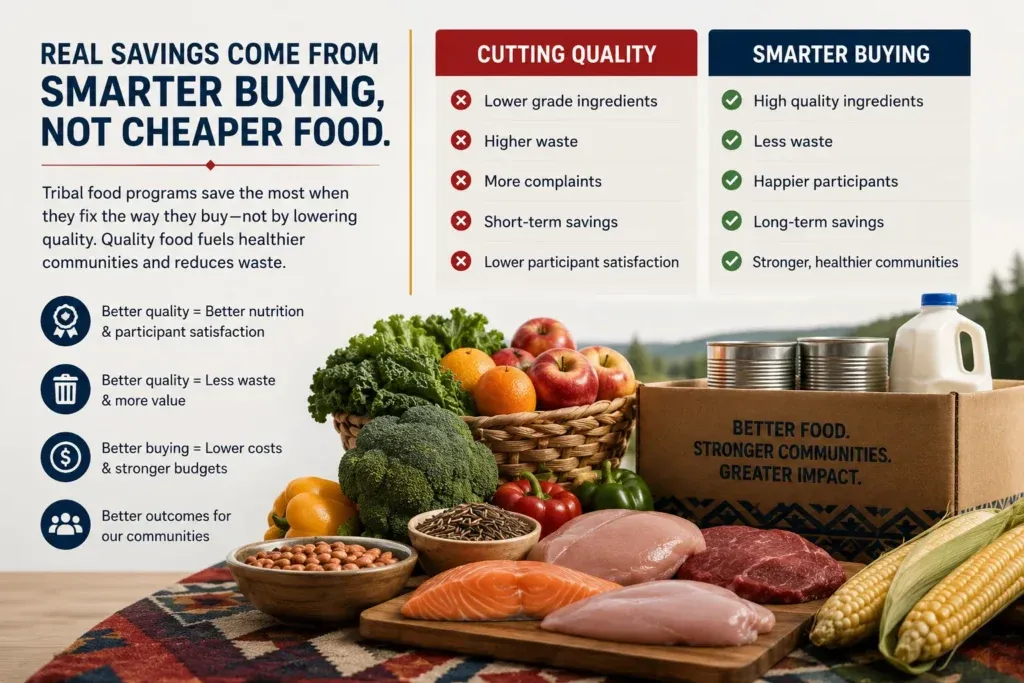
Cutting quality to save money always backfires. Lower grade meat, canned vegetables with more sodium, bread that falls apart. Participants complain, waste goes up, and you buy more.
Real savings come from how you buy, not what you buy. The tribes saving the most still serve good protein, fresh produce, whole grains and traditional foods like bison, walleye, wild rice and blue corn. They just stopped paying for inefficiency.
Stop Spot Buying, Start Contract Buying
Spot buying is calling three vendors each week for the lowest price that week. You pay retail plus volatility.
Contract buying through a group purchasing organization locks a price for 12 months with a defined cap. Native Purchasing Group aggregates volume of many tribes and negotiates umbrella agreements that include deep discounts and better service levels you could not get alone.
One tribe in the Southwest was buying chicken breast spots at 3.89 per pound. By moving to a contracted GPO poultry line they locked at 3.12 per pound for the year. Same brand, same grade. One item saved over 28,000 dollars.
Action Step: Pick your top 20 items by spend. Get them on contract first.
Consolidate From Eight Vendors to Two or Three
Many programs have six to ten food vendors. Each has a delivery fee, a minimum and a different invoice.
The most efficient programs run with one broadline prime for 70 to 80 percent of volume, one produce specialist, and one local or Native supplier for traditional foods. When you give a vendor 300,000 dollars a year instead of 40,000, they do not short your order.
Action Step: Run a 90 day spend report by vendor. You will likely see 70 percent of spend is already with two vendors. Formalize that.
Fix Your Product Specifications
Vague specs cost money. If your sheet says canned green beans, you get the cheapest can. If it says canned green beans, Grade A, low sodium, 6 per 10 can, USA grown, you control quality and price.
Good specs describe quality objectively, allow an approved equal to stay competitive, and name the pack size that reduces labor.
This is where you write in traditional foods. Instead of beef, write bison, ground, 90 lean, 10 lb chub, Native sourced preferred. Instead of fish, write walleye fillet, wild caught, individually quick frozen, 4 oz portion. Clear specs let Native producers compete and win.
Action Step: Rewrite your top 30 specs this month using USDA Food Buying Guide language.
Use Self Determination, LFPA and Local Buying Together
This is the biggest change in 2026. Tribes in the Self Determination Project can purchase food directly from vendors of their choosing rather than taking what the warehouse sends. Leaders report this helps manage disruptions because they can source locally when the federal system fails. Participants in the pilot adapted more quickly than communities relying solely on federal distribution.
Combine that with LFPA. LFPA lets tribal governments buy regional foods to meet immediate needs and keep money local.
Smart programs use LFPA and self determination dollars for high value traditional foods participants love, and use GPO contracts for staples where price matters most.
Action Step: Map your menu. Mark which items must be commodity, which can be local or Native sourced, and which can be GPO contracted.
Control Waste and Inventory
You cannot save your way out of waste. One program threw away 18 percent of produce from overordering and poor rotation. That is one in five dollars in the trash.
First, first in first out.
Label every shelf and put new products back.
Second, par levels.
Set minimum and maximum based on actual usage. Order only to par.
Third, standardized portions.
If your menu says 4 ounce chicken, use a scale. Overportioning by one ounce on 200 meals a day is 12.5 pounds wasted daily.
Programs that added a weekly count for produce and protein cut waste from 14 percent to under 6 percent in two months.
Action Step: Start with produce and protein only. Count them every Monday and Friday.
Align Menus With Procurement
Many menus are written without purchasing. Then purchasing must find 40 specialty items for one week.
Flip it. Plan a four week cycle menu based on what you can get consistently at a good contracted price and what is in season locally.
Wild rice blended 50 percent with brown rice keeps taste and cuts cost. Bison served once a week as a featured traditional meal drives participation up and waste down.
Action Step: Rewrite one week based on contracted items and measure plate waste and cost per meal.
Track Savings and Report to Council
What gets measured gets funded. Most programs do not track savings, so the council only sees costs going up.
Create a one page report. Before price, after price, quantity, dollars saved. Do it monthly. When you show you saved 42,000 dollars in six months while increasing fresh produce and traditional foods, you get support for equipment and more buying authority.
A Real Example
A tribe in the Upper Midwest running FDPIR, elder meals and Head Start spent about 620,000 dollars annually on food with nine vendors, mostly spot buying.
Over 120 days they moved top 25 items to a GPO contract through Native Purchasing Group, consolidated to two primaries plus one Native farm, rewrote specs and started weekly inventory. They used self determination to source bison and walleye through a tribal vendor at lower cost than the national brand.
Result after six months
- Cost per meal dropped from 4.82 dollars to 3.71 dollars.
- Waste dropped from 13 percent to 5 percent.
- Elder participation rose 11 percent.
- Annualized savings about 138,000 dollars, roughly 22 percent.
They changed their buying method, not their mission.
Your 30 Day Quick Start
Week One
Pull the last 90 days of invoices and rank the top 20 items by spend.
Week Two
Review vendors and delivery fees. Choose your prime.
Week Three
Request contracted pricing for top 20 and rewrite specs.
Week Four
Set par levels and count inventory twice a week for produce and protein.
Most programs see 8 to 12 percent savings from those steps alone.
Final Thought
Cutting food costs without cutting quality is not about finding cheaper food. It is about removing hidden costs built into how tribal programs were forced to buy for decades. Emergency retail buys, too many deliveries, vague specs and waste are what cost you 18 to 28 percent, not the food itself.
Tribes now have more authority than ever to choose their own foods, support producers and negotiate like large buyers. The programs winning in 2026 use that authority.
Compare your top 20 items to pre-negotiated contracts available through Native Purchasing Group. You’ll quickly see where your program can save. If you’d like personalized guidance, contact our team to discuss your procurement goals and available contract options.
Frequently Asked Questions
How can tribal food programs cut costs without reducing quality?
Move from spot buying to contracted pricing, consolidate vendors, write clear specs, reduce waste, and blend GPO staples with local and traditional foods through self determination and LFPA.
Does using a GPO satisfy competitive bidding for federal food programs?
In many cases yes, when the GPO contract was competitively solicited and meets 2 CFR 200. Keep documentation and price reasonableness in your file and confirm with your grant officer.
What is the FDPIR Self Determination Project?
It is a USDA project that lets tribes purchase foods directly for FDPIR packages rather than receiving them through the warehouse system. It supports food sovereignty and helps during disruptions.
How can tribes buy traditional foods affordably?
Write specs that allow Native sourced products, use LFPA and self determination funds for those items, and use GPO contracts for staples to offset cost.
What is the fastest way to see savings this month?
Lock your top 20 items to a contracted price, set par levels for produce and protein, and start counting waste.