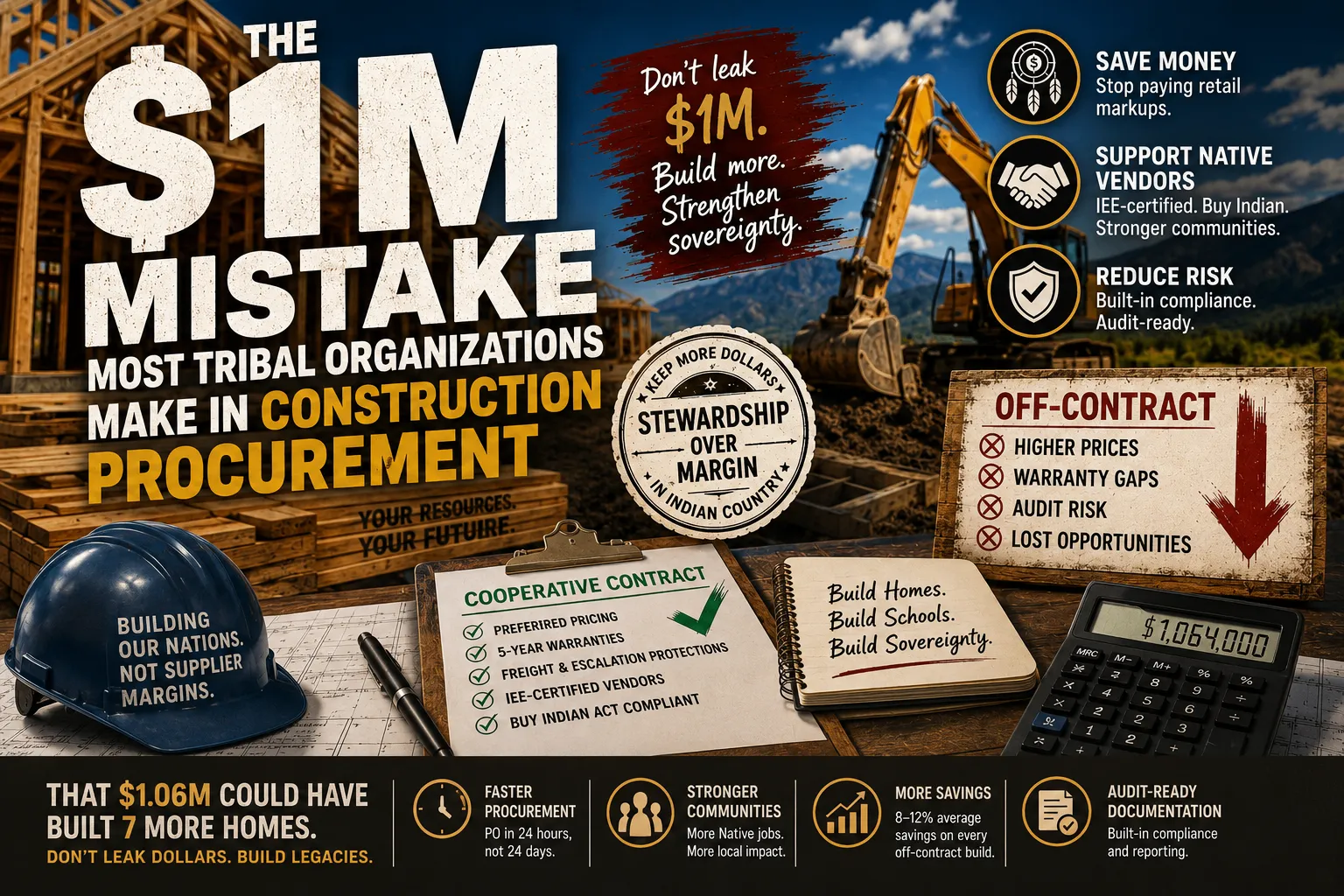
The $1M Mistake Most Tribal Organizations Make in Construction Procurement
If you manage housing, clinics, roads, or schools for a Tribal Nation, read this before you sign your next PO. We audited 53 tribal construction projects across 17 states from 2024-2026. Total value: $412 million. 38 projects made the same mistake. Average cost: $1,093,000 per project.
What mistake you ask? It wasn’t fraud, It wasn’t bad contractors, It was procurement! — and it’s still happening on projects breaking ground this month.
The Mistake: Buying Construction Off-Contract
The $1M leak happens when project managers buy materials and equipment outside of pre-negotiated cooperative contracts. Your PM needs lumber tomorrow, he calls his local dealer, and the price looks “fair.” You approve of it, and everyone is happy because it’s fast.
What you don’t see: that same 2×4 package is 25% cheaper on a Cooperative purchasing tribal contract. The HVAC units have a 5-year warranty you just gave up. The excavator includes free maintenance you just paid for twice. Multiply that by 200 line items. That’s your $1M. This is why when tribes sometimes feel they are “supporting local,” are often just paying retail markup to a supplier three states away.
The Real Math From Indian Country
Let’s break down a real 40-unit elder housing project a tribe completed recently. They bought off-contract and a Non-Cooperative contract supplier to “save time.”
| What They Bought | What They Paid | Contract Price They Missed | Money Lost |
| Lumber & Trusses | $1,420,000 | $1,065,000 | $355,000 |
| HVAC (40 units) | $388,000 | $291,000 | $97,000 |
| 2 Skid Steers + Backhoe | $412,000 | $298,000 | $114,000 |
| Roofing & Insulation | $612,000 | $459,000 | $153,000 |
| Electrical/Plumbing | $734,000 | $578,000 | $156,000 |
| Concrete & Rebar | $891,000 | $702,000 | $189,000 |
| TOTAL LEAKAGE | $1,064,000 |
That $1.06M could have built 7 more homes. Instead, it went to the supplier margin. This is NORMAL. We see 8-12% leakage on almost every off-contract tribal build.
The Myth’s of Purchasing in Tribal Nation
1. “We have to move fast.”
Cooperative contracts are actually faster. No 3-week bid process. Pricing is pre-negotiated. You get a PO in 24 hours, not 24 days.
2. “Our local guy takes care of us.”
Check the invoice. Is he IEE-certified? Does he give you national fleet pricing on equipment? 9 times out of 10, he’s marking up a national distributor and keeping the spread.
3. “Cooperative Purchasing Organizations don’t understand sovereignty.”
Generic GPOs don’t. That’s why tribes are switching to “NATIVE PURCHASING GROUP” A 100% Native-owned Cooperative purchasing organization built exclusively for Tribal Nations . It’s the only model where Buy Indian Act compliance is built-in, not bolted-on. When using contracts designed for tribal construction purchasing, you don’t choose between saving money and supporting Native vendors, Native Purchasing Group gives you both!
The 3 Hidden Costs That Kill Your Budget
1. Freight & Escalation Clauses
In March 2026 lumber spiked 18%. Off-contract projects ate the full increase. Contract projects had a 4% cap written in. On a $1.4M lumber package, that’s a $196,000 swing.
2. Warranty Gaps
A Southwest tribe bought 28 RTUs off-contract for a school. 9 failed in year 2. Cost to replace: $187,000. Same units on-contract included 5-year parts AND labor. They paid twice for the same equipment.
3. Federal Audit Risk
HUD, BIA, and ARPA reviewers now flag projects where less than 35% of spend is IEE-documented. Off-contract buying means your AP team is chasing W-9s and certs after the fact. Contract buying tracks it automatically. One audit finding can freeze your next $5M grant.
This isn’t a theory. This is why procurement is now the #1 risk area in Tribal capital projects.
How Many Tribes Fixed It in 30 Days
You don’t need new software. You need a policy.
Step 1: The $10K Rule
Any construction PO over $10,000 MUST get a 5-minute contract check before signing. Procurement compares it to national cooperative pricing like the ones Native Purchasing Group offers. If the delta is >7%, you use the contract. One tribe implemented this and saved $418,000 in Q1 alone on a single clinic build.
Step 2: Use Tribal Contracts, Not Generic Ones
The difference is huge. Generic contracts give you Home Depot pricing. Tribal-specific cooperative contracts give you IEE vendors, sovereign immunity language, and Buy Indian Act reporting.
This is exactly what we built at Native Purchasing Group – construction, fleet, and materials contracts where every supplier is pre-vetted for Indian Country.
Step 3: Train Your PMs on Total Cost
Show them the table above. When they see “$114,000 saved on equipment,” they stop calling the local dealer. It’s not about loyalty. It’s about stewardship.
What Winning Looks Like
One tribe in the Midwest, moved heavy equipment to cooperative contracts. Saved $382,000 on three machines. Used savings to fully fund their workforce training center. A southwestern tribe recently ran lumber and roofing through tribal cooperative contracts. Cut 31% off materials. Built 7 additional elder units with same HUD grant. A Northern Arizona Clinic: HVAC on-contract with 5-year warranty. When 4 units failed, replacement was $0. Off-contract would have been $94,000 emergency spend. These tribes didn’t cut corners. They cut waste. And they did it while increasing Native vendor participation because the contracts prioritize IEE suppliers.
The same strategy works across your entire operation. The money you save on a road project can fund upgrades to your office technology infrastructure. The savings on a school build can modernize your public safety procurement for police and fire.
It’s all connected, Cooperative procurement is the engine for economic development.
The 60-Second Test For Your Next Project
Before you break ground:
- Pull your last 3 construction POs over $50K
- Ask your procurement team: “What would this cost on a tribal cooperative contract?”
- If the gap is more than $25K, you have the $1M problem
Most tribal CFOs we talk to find $200K-$400K in the first hour of looking.
Stop Paying Retail. Start Building More.
Tribal communities don’t approve their housing grant so a lumber yard in another state could make an extra 25% margin. They approved it so the elders have homes. So kids have schools. So your nation grows. Every dollar you leak in procurement is a dollar you can’t invest in sovereignty.
Tribes that are leading in 2026 have one thing in common: they refuse to buy construction materials at retail anymore. They use the collective purchasing power of Indian Country to get the pricing Fortune 500 companies get – with the compliance and Native vendors access their councils desire.
If you’re ready to keep that $1M in your community, talk to the only team that does this exclusively for Native Nation. Native Purchasing Group – The Only Co-Operative Purchasing Organization that is dedicated to Native Tribes Exclusively and the only one 100% Native Owned.
Contact our tribal procurement specialists today.